
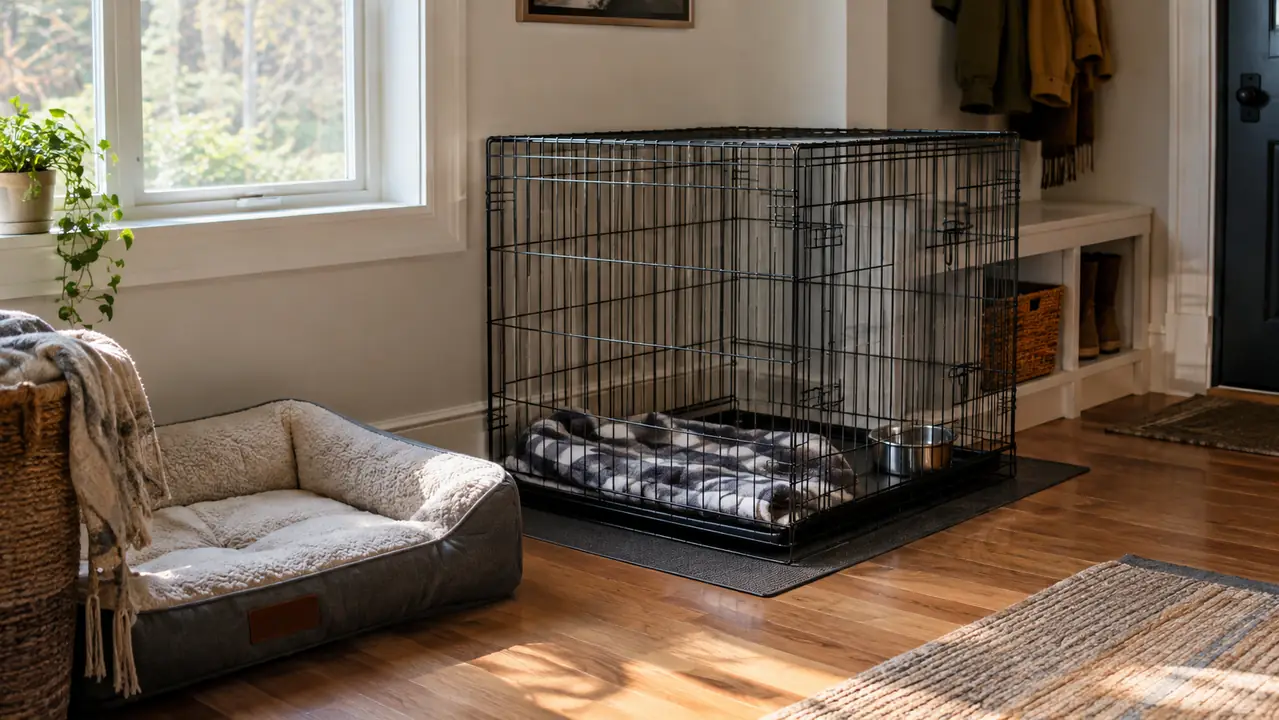
Pick the right crate and you'll forget you own it. Pick the wrong one and you'll find out at 2 a.m., when a 70-pound dog who does not want to be confined throws himself at the door and the latch gives. In eleven years of running a small in-home boarding business out of my ranch house near Loveland, Colorado, I've seen both endings, and I've woken up to both.
So when someone asks me to compare the MidWest Homes for Pets iCrate 42-Inch with the FDW Folding Crate, here's the short answer. The FDW is a perfectly good crate for a calm dog who rarely tests it. The MidWest iCrate is the one I'd trust with a houseful of guest dogs, and it's the one I'd buy again. The rest of this article is the why.
How I Tested Both Crates
I'm Renata Ellsworth. I ran a licensed in-home boarding business out of the converted mudroom of my single-story ranch house, usually four to six guest dogs at a time, until I closed that side of things a few years back. Juniper, my Australian Shepherd mix, still supervises every dog who comes through the place, and she has firm opinions about which crates are up to standard. Over the years, both of these crates have spent time in that mudroom.
The MidWest Homes for Pets iCrate was my workhorse for large breeds, the crate I set up for the 70-pound-and-up guests. The FDW showed up when a client brought her own crate for her Labrador and left it here for a week of boarding. That gave me time to live with both side by side, run them through the same wash-down in the side yard, and fold and unfold each one more times than I can count.
I tested the things that actually matter when you use a crate every day: whether the latch holds when a dog leans on it, whether the pan slides out without scraping your knuckles, whether the whole crate tips when a big dog shifts his weight, and how long it takes to get clean. I also paid attention to the small stuff, like whether the door opens one-handed when you're holding a leash and a bowl of food, and whether the crate stays put on a hard floor.
The week I had both crates set up, the rotation included a 70-pound Labrador who leaned on every door in the house, a senior cattle dog who needed a quiet corner, and Juniper, who treated both crates as her personal observation posts. The Labrador was the real test. He pushed against the front of a crate the way some dogs bark at the mailman, steady pressure, all night if you let him. Both crates held him, I should say that plainly. But the MidWest held him without the door rattling, and the FDW developed a rattle by day three that I could hear from the kitchen.
| MidWest iCrate 42-Inch | FDW Folding Crate | |
|---|---|---|
| Price | Costs more up front, but holds resale value | The budget pick, costs noticeably less |
| Doors | Two doors: side and top, handy for car rides | Single front door |
| Latches | Slide-bolt latches that hold when a dog leans on them | Standard latch a determined dog can work loose |
| Pan | Composite pan resists chewing and wipes clean | Plastic tray that can crack if chewed |
| Weight | Heavier frame, feels planted on the floor | Lighter, easier to carry one-handed |
| Warranty | One-year manufacturer warranty and parts | Limited warranty, harder to claim |
| Best for | Boarding, travel, dogs who push at the door | Occasional home use with a calm dog |
What the Size Chart Actually Means
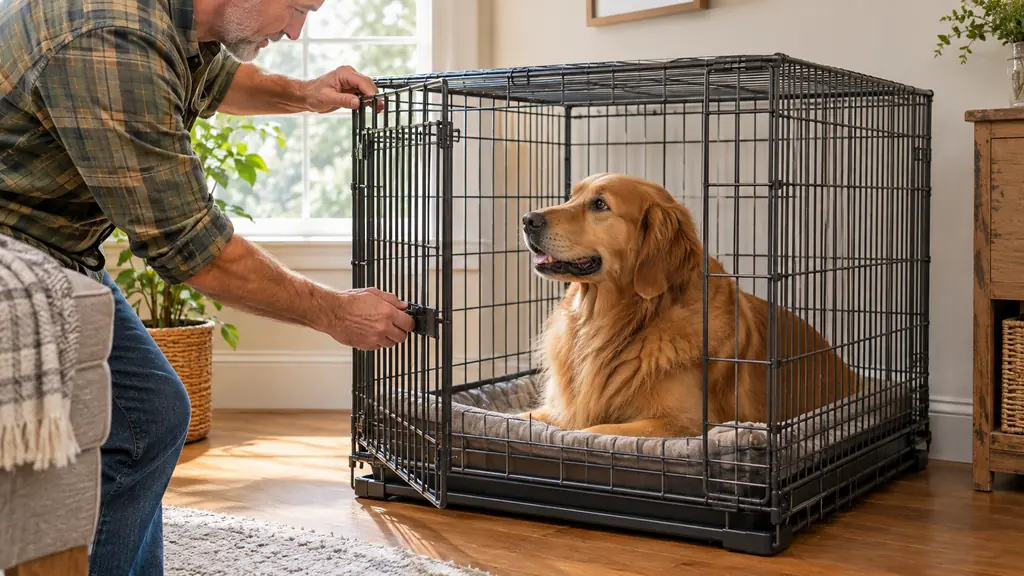
The 42-inch in the name refers to the length of the crate, and MidWest Homes for Pets sizes it for dogs in the 71-to-90-pound range. That's a large piece of gear, roughly the size of a coffee table, and it will dominate a room, so measure your space before you order. Measure your dog from the tip of the nose to the base of the tail, then add a few inches. The rule I used in boarding was simple: the dog should be able to stand up, turn around, and lie down flat without scrunching. If you're between sizes, go up, because a crate that's too small is a misery for the dog and a problem for you.
Both crates come in a range of sizes, so this 42-inch comparison only makes sense if you're shopping for a large breed. For a 48-pound dog like Juniper, I'd pick a smaller size in either brand. The differences I'm describing here, the latch, the pan, the weight of the frame, carry across the whole lineup, so the verdict doesn't change with the size.
What I Check Before I Trust Any Crate
After eleven years, I have a short checklist I run through before a crate earns a spot in my boarding room. First, the latch. I push on the door with my hip the way a big dog would, and I look for any give. Second, the pan. I pull it all the way out and look at the edges, because that's where plastic trays crack first and where composite pans earn their keep. Third, I fold the crate flat and set it back up, because if you travel, you'll do that a hundred times, and a crate that fights you will end up left at home.
I also check the feet. The MidWest has plastic feet that keep the wire off the floor, which matters if you're setting it up on wood or tile. The FDW has similar feet, but they're smaller. Neither crate will scratch a good floor if you're careful, but a mat under either one is cheap insurance, and it makes cleanup easier too. Anything that's easy to hose off and dry will do, a rubber mat, a piece of linoleum, even a large bath mat.
Where the MidWest iCrate Wins
The first thing I noticed was the latch. The MidWest uses a slide-bolt latch that sits flush against the frame, so a dog can't hook a paw or a tooth into it. That matters more than you'd think. I once boarded a Great Dane mix who could open a standard latch by shoving the door with his chest. He never got out of the MidWest. The FDW has the standard kind of latch, which is fine for most dogs, but it's the first thing I'd worry about with a determined chewer or a dog with separation anxiety.
The second thing is the pan. The MidWest uses a composite pan that's sturdier than the plastic tray on the FDW. A nervous beagle we boarded one Christmas chewed a plastic tray into splinters overnight; the composite pan on the MidWest survived the same dog. The pan also slides out for cleaning, which sounds like a small thing until you're hosing one down at 6 a.m. and trying to get it dry before the next guest arrives.
The double doors are a genuine convenience. The side door is the one you'll use in the house, and the top door is perfect for the back of the Subaru when I'm taking a dog to the vet, because you can lift a nervous dog straight up through the top instead of dragging him out the front. The frame is heavier gauge wire, so the whole crate feels planted. A big dog can throw himself against the side and the crate shifts an inch instead of tipping. The MidWest Homes for Pets iCrate also comes with a divider panel, which lets you shrink the space for a puppy and expand it as the dog grows. That's a feature the FDW doesn't offer, and it's one of the reasons the MidWest can be the only crate you ever buy.
Where the FDW Wins
I want to be fair here, because the FDW has real strengths. The first is price. It costs noticeably less than the MidWest, and for someone who needs a crate for a couple of hours a day with a calm dog, that's a reasonable way to save money. I'd rather see a dog properly crated in an FDW than not crated at all because the owner couldn't swing the cost of the MidWest. A crate you can afford and will actually use beats a crate you couldn't afford and resent, and there's no point pretending otherwise.
The second is weight. The FDW is lighter, and if you're hauling a crate in and out of a car every weekend, that matters. I could fold it and carry it one-handed. The MidWest is heavier, which is exactly why it feels sturdier on the floor, but there's no pretending it's a feather. If your crate lives in one spot and rarely moves, the weight difference is a non-issue. If you travel constantly, the FDW is easier to lug around, and that ease might mean the difference between taking the crate and leaving it home.
There's one more thing the FDW has going for it, and it's the same thing every budget crate has going for it: it's easy to replace. If the MidWest is the crate you'll hand down to the next dog, the FDW is the crate you can beat up without guilt. For a puppy who's still learning to be calm in a crate, or for a foster dog who's only staying a few weeks, that's a real advantage. You're not out much if it gets chewed or bent.
The FDW is a fine crate for a calm dog who never tests the door. The MidWest is the one I'd trust at 2 a.m.
The crate I'd trust with a houseful of guest dogs
After eleven years of boarding dogs in my home, the MidWest iCrate 42-Inch is still the crate I recommend to anyone with a large breed. It holds, it cleans up, and it's still going strong. Check today's price on Amazon.
Amazon Check Today's Price on Amazon →Who Should Buy Which
Buy the MidWest iCrate if your dog is in the 71-to-90-pound range, if you travel with the crate, if you have a dog who leans on the door or chews, or if you plan to use it every day. Buy the FDW if you need a crate for occasional use, if your dog is calm and never tests the latch, or if budget is the deciding factor and you're honest that the crate will live in one spot and rarely move. There's no shame in either answer, but they are different answers.
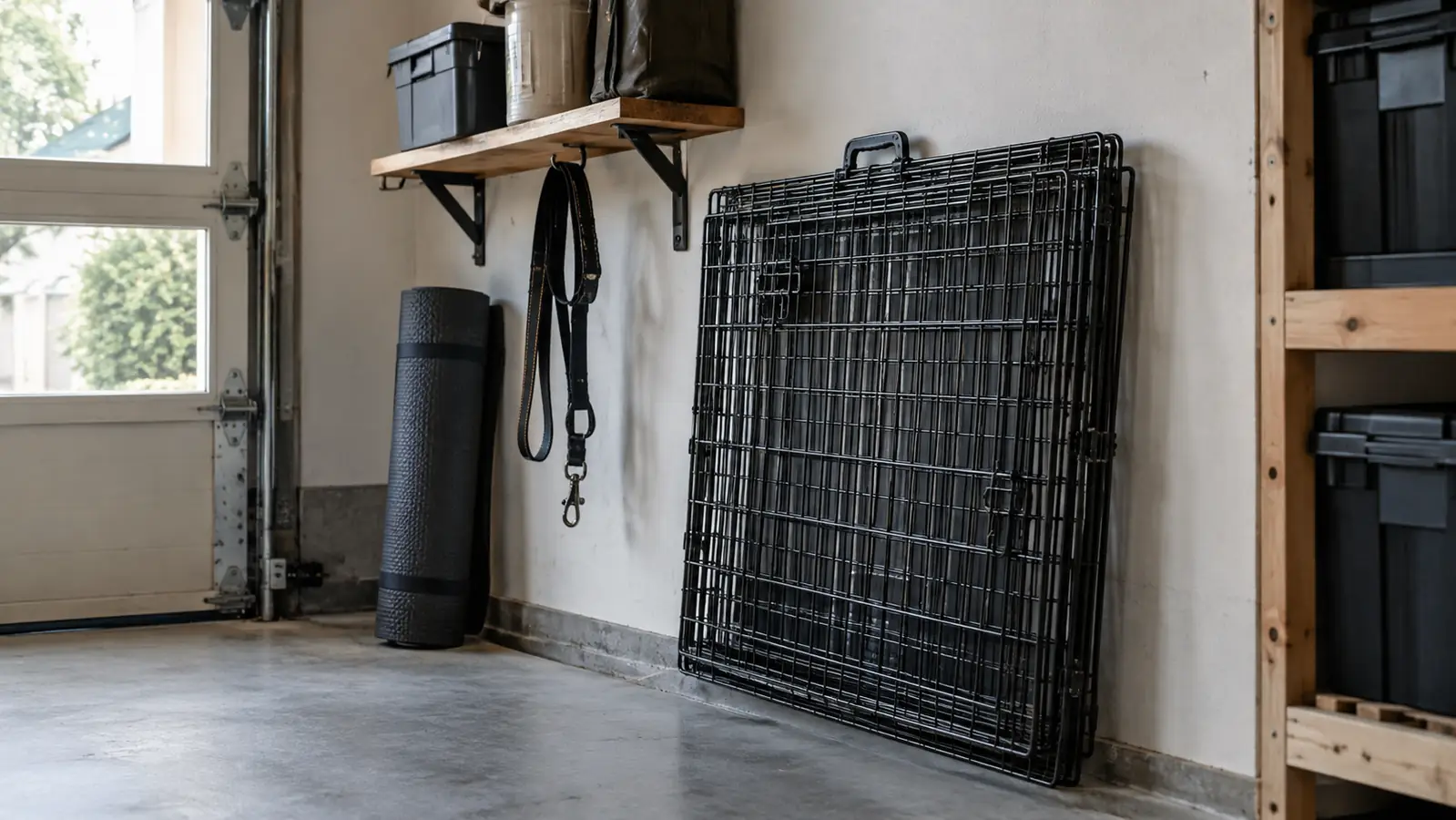
My rule of thumb after all those years is simple: buy the best crate you can afford, because the crate is doing a real job. It's keeping your dog safe and keeping your house intact. The MidWest iCrate has outlasted every budget crate that ever came through my boarding room, and it's the one that's still in my garage, folded flat against the wall, waiting for the next dog who needs a safe place to sleep.
The Bottom Line
If you're still on the fence, think about what the crate is for. It's not a piece of furniture. It's a tool you'll use every single day for years, and it's the one piece of gear that has to hold when everything else in the house is chaos. The MidWest iCrate 42-Inch costs more up front, but it holds up, it cleans up, and it holds a determined dog. The FDW is a solid budget option for the right household. In my book, anyone who wants a crate that will still work the same five years from now should go with the MidWest Homes for Pets iCrate, and anyone who needs to save money today and has a calm, easy dog will do fine with the FDW.
Ready to pick a crate that will last?
The MidWest iCrate 42-Inch has been my pick for large breeds since my first year of boarding. See today's price on Amazon and read what other owners say.
Amazon Check Today's Price on Amazon →