
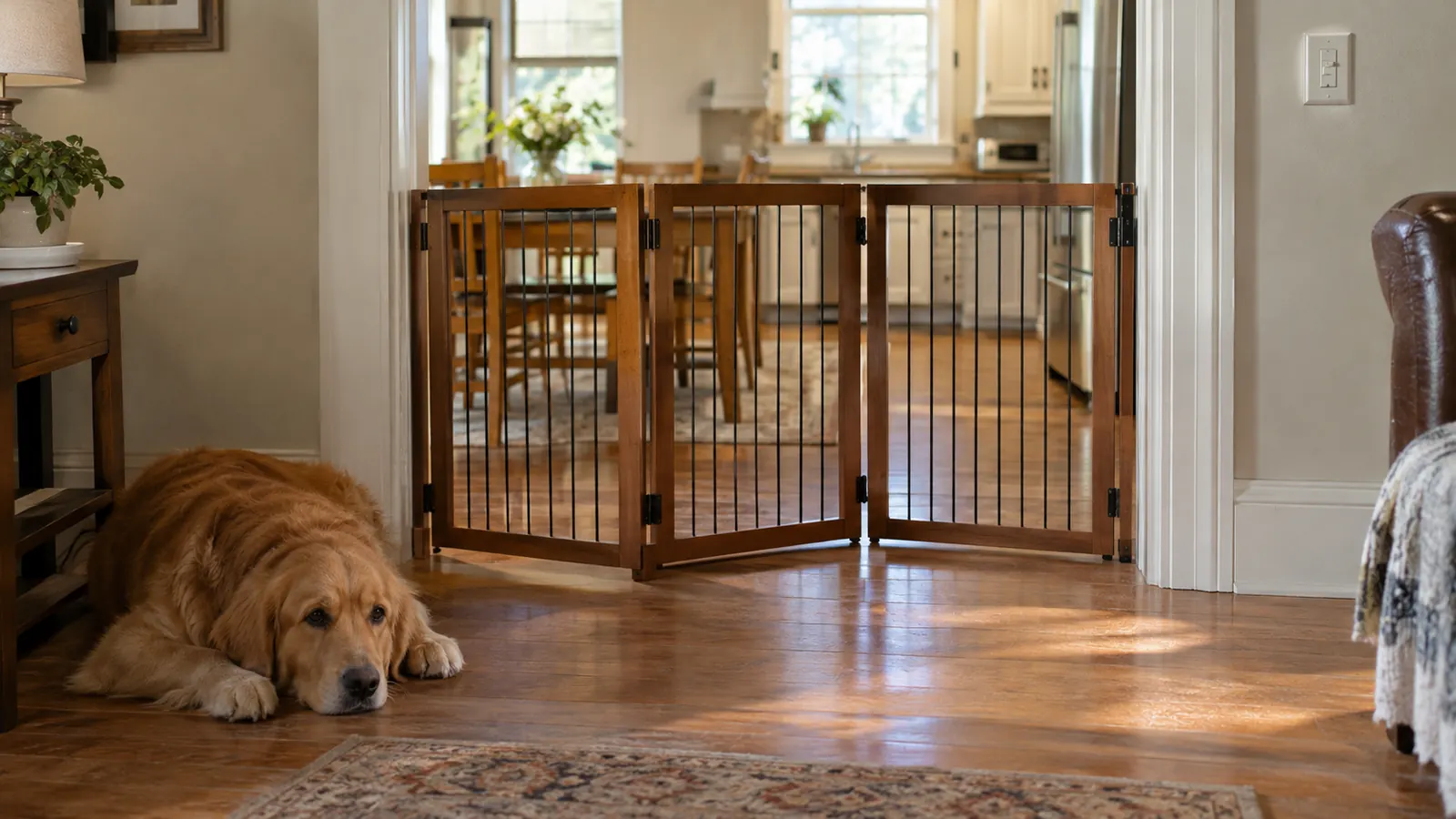
When I ran my licensed in-home boarding setup outside Loveland, I learned to judge pet gear the way a cook judges a knife: does it still do its job at 6 a.m., half asleep, with a house full of dogs who don't care about your plans? I retired from boarding last year, but my own dog Juniper, a 7-year-old Australian Shepherd mix, still supervises every guest that comes through. That means I still need a way to keep a nervous newcomer separated from the rest of the house without turning my day into a constant door-shutting relay. The PETMAKER 4-Panel Indoor Foldable Dog Pet Gate has been my answer for over a year now, and it has earned a permanent spot in my mudroom.
This is not a review written after a weekend of testing. This is a gate that has been knocked into, leaned on, climbed past, and once accidentally driven into by a very excited Lab who forgot the gate was there. It has held up through a full year of boarding seasons, which in my book is about four dog-years of real-world abuse. I kept a log of what broke and what didn't in that room, and this gate never made it onto the repair list.
The Quick Verdict
The PETMAKER 4-panel gate is the most flexible freestanding gate I've used in years of boarding. It won't stop a determined jumper, and the latches take two hands, but for blocking a doorway, narrowing a hallway, or creating a quick pen in a mudroom, it's hard to beat for what it is.
Amazon Check Today's Price →The gate that survived a year of guest dogs
If you need a freestanding gate that sets up in seconds and actually stays where you put it, this is the one that earned its spot in my mudroom. Check today's price on Amazon and see if it fits your doorway.
Amazon Check Today's Price on Amazon →How I've Used It
My setup is a single-story ranch with a mudroom I converted into the boarding room years ago. That mudroom has two doorways: one to the kitchen and one to the side yard. The PETMAKER gate lives in the kitchen doorway, and it gets opened and closed more times in a day than my refrigerator door.
The gate is four panels that fold like an accordion and stand on their own. Each panel is roughly 24 inches wide, so the full span comes to about 96 inches when straight. You can set it straight across a doorway, angle it into a pen shape, or fold it down to a smaller width for a narrow opening. In my house it sits across a 36-inch doorway, and I've also used it to block the hallway to the bedrooms when a guest dog needed quiet time away from the group. During one Christmas week I had four guest dogs, and I folded the gate into a U-shape around a dog bed in the corner of the mudroom so the shyest one could eat without the others crowding in.
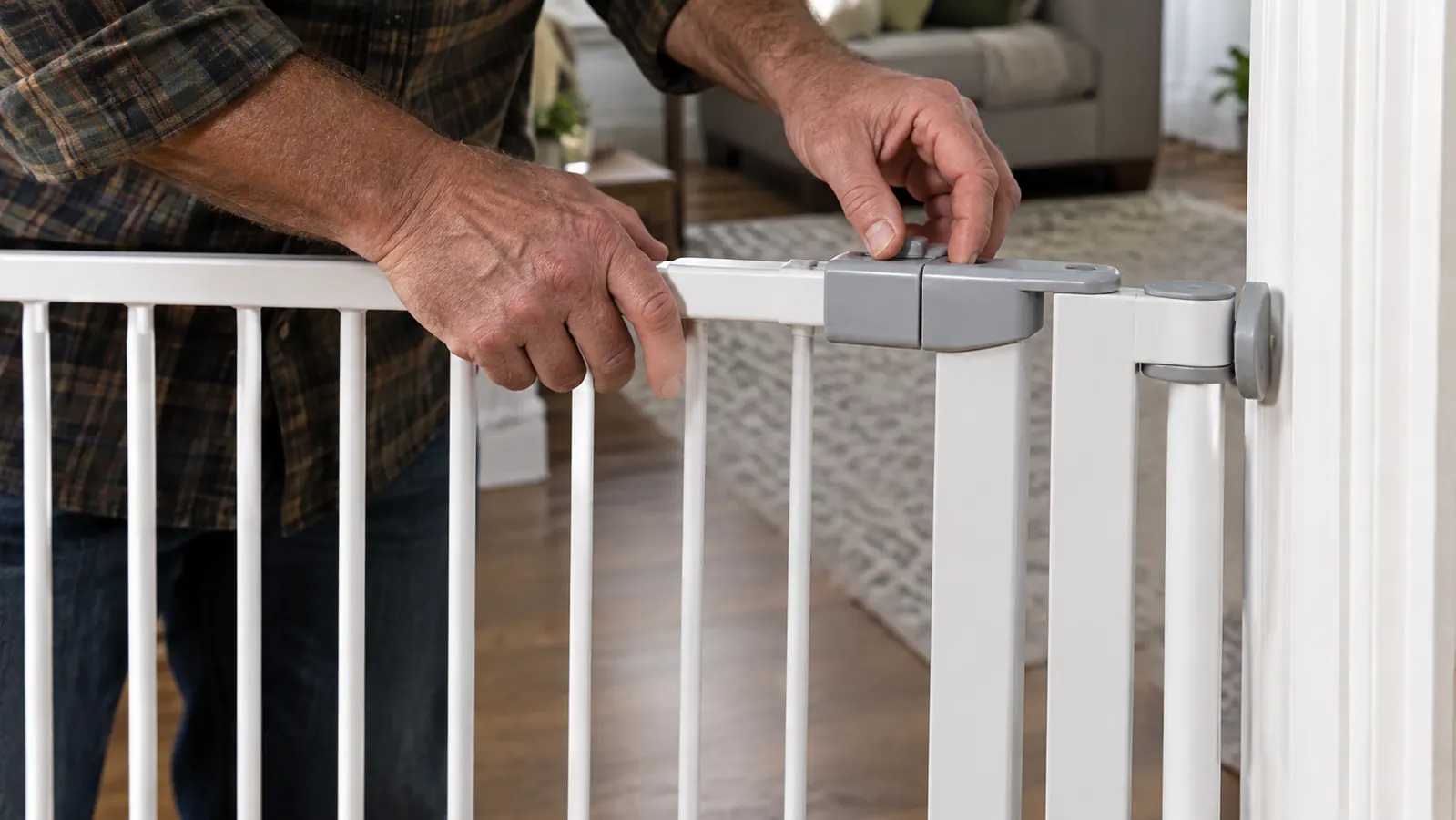
The panels are held together by hinges, and the whole thing locks into a straight line with a sliding latch at the top of each joint. There are no tools involved, no hardware to mount, and no holes in my doorframe. That matters to me because I rent my house out to a tenant when I travel, and I don't want to explain a dozen screw holes to anyone. The first gate I used in that same doorway was a pressure-mounted wooden one, and it left two divots in the trim that I had to fill with wood putty before the tenant moved in.
I also used it as a temporary pen when a guest needed to be separated during meals. I folded the gate into a square around a mat and a water bowl in the corner of the mudroom. That worked better than a crate for a dog who was stressed by closed doors. The crate made one guest panic, but the open-top pen made from this gate let her see the room and settle down. It took me about a minute to set up and about thirty seconds to take down. That one feature alone justified the purchase.
What Held Up Over a Year of Use
The first thing I noticed is how quickly it sets up. I can unfold it, lock the latches, and have it standing in a doorway in under twenty seconds. When a new guest dog arrives and I need to create a safe space fast, that speed matters. The gate is also light enough that I can carry it with one hand while holding a leash with the other. On the day I brought it home, I timed myself from box to standing gate and it took about a minute the first try. Now it's muscle memory.
The panels are made of a metal frame with a mesh fabric in the middle. After a year of daily use, the mesh has no tears, the hinges have no wobble, and the latches still click into place firmly. I've had cheap plastic gates that developed cracks within months, and this one has none of that. The metal frame is sturdy enough that a 70-pound dog leaning against it doesn't bend it out of shape. One afternoon a Great Dane mix who was staying with us decided to sit on the lower bar while he waited for his dinner. The gate bowed maybe an inch and then sprang back when he stood up. That sold me on the frame.
One thing I didn't expect: the gate has survived being stepped on. A 180-pound guest owner stepped right on the lower bar while reaching for a leash. I thought it would snap. It didn't. The bar flexed and the gate stayed upright. I have not tested that on purpose, but I did not have to replace the gate afterward.
It also cleans up well, which is the real test in a boarding house. Dogs drool on it, paw at it, and occasionally have accidents near it. I wipe the frame down with a disinfectant wipe almost daily, and the mesh fabric has held up to that without fading or fraying. The whole thing can be wiped down in a couple of minutes, which is more than I can say for the fabric gates I've owned in the past that had to be thrown in the washing machine and came out twisted. I also appreciate that the mesh lets me see through it. When a guest dog is on the other side, I can check on them without opening the gate and letting everyone else through.
Where It Falls Short
Let me be honest about the limitations, because they matter. The gate is 30 inches tall. That is plenty for most dogs, but a determined jumper can clear it. I boarded a border collie once who figured out she could put her front paws on the top bar and vault over in one motion. The gate did its job of slowing her down, but it did not stop her. If you have a dog who treats fences as suggestions, you need something taller or something mounted to the wall.
The latches also take two hands. Each joint has a sliding latch that you have to pull back and hold while you fold or unfold the gate. When I'm carrying a bowl of food in one hand and trying to open the gate with the other, I have to set the bowl down first. It is a small annoyance, but it comes up several times a day. I tried using my elbow once and nearly dropped a full bowl of kibble on the floor, so now I just accept the extra step.
The rubber feet on the bottom are decent, but on a smooth tile floor the gate can slide if a dog really throws its weight against it. On carpet or a rug it stays put much better. I solved this by putting a non-slip rug pad under the section that sits in the doorway, and that fixed the problem completely. If your floors are all hard surface, budget a few dollars for a rug pad or plan to use the gate mostly on carpet.
How It Compares to Other Gates I've Tried
Before the PETMAKER, I used a pressure-mounted wooden gate that had to be installed in a doorway and removed every time I needed to pass through. It worked, but it was heavy, it left marks on the doorframe, and it only worked in doorways. The PETMAKER's big advantage is that it works anywhere: across a doorway, in the middle of a room, or folded into a pen around a dog bed. On a day when I had a nervous beagle who wanted to hide under the kitchen table, I folded the gate into a loose circle around the table legs and gave him a quiet corner without shutting him away from the room.
I also tried a retractable mesh gate that rolls up into a cassette. It was easy to store, but the mesh sagged after a few months and a determined dog could push under it. The PETMAKER's metal frame gives it a rigidity that the retractable gate never had. The retractable one also made a loud rattling noise every time a dog bumped it, which got old fast when a guest was sleeping in the next room.
The one thing the PETMAKER doesn't do is attach to a wall. If you need a gate that a 90-pound dog absolutely cannot move, you need a hardware-mounted gate. But for my use, keeping guest dogs in one part of the house, the freestanding design is actually better because I can move it in seconds. When the side yard door needed to stay open for air on a warm afternoon, I could shift the whole gate over a few feet and still keep the kitchen off limits. You can't do that with a mounted gate.
Pros and Cons
What I Liked
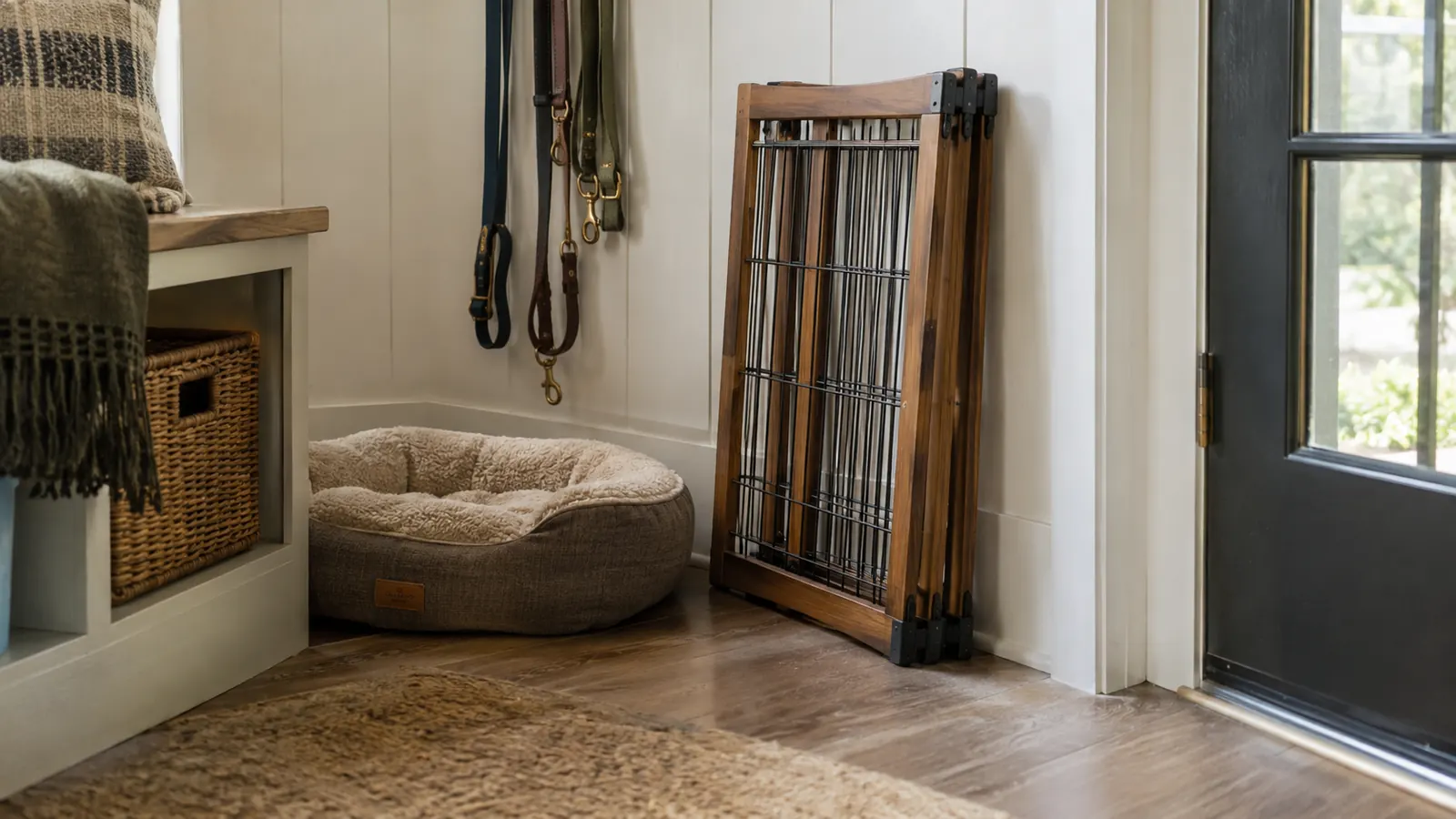
- Folds flat and stores easily
- Sets up in seconds with no tools
- Metal frame and mesh held up for a year of daily use
- Works in doorways, hallways, or as a free-standing pen
- Easy to wipe clean
- Light enough to carry one-handed
Where It Falls Short
- 30-inch height won't stop a determined jumper
- Latches need two hands
- Can slide on smooth tile without a rug pad
- Not a permanent barrier for heavy chewers or escape artists
- Panels don't lock into a rigid wall mount
After a year of daily use in a boarding room, the mesh is intact, the hinges are tight, and the latches still click. That is more than I can say for the three plastic gates I went through in my first two years of boarding.
Who This Is For
This gate is for someone who needs flexibility more than maximum security. If you want to block a doorway when you're cooking, keep a dog out of a room during the day, create a quick pen in a living room, or take a gate with you when you visit family, the PETMAKER is a great fit. It is also ideal for renters because it leaves no marks on the walls. I set it up at a friend's house last summer when we were dogsitting her elderly spaniel, and she was able to hand it back folded flat in the same box it came in.
It's especially good for people who have multiple dogs and need to separate them quickly. In my boarding setup, I could fold the gate into a U-shape around a dog bed in seconds, giving a nervous newcomer a safe spot without shutting them in a room alone. That kind of flexibility is hard to find in a gate this flexible. For a single-dog household it might be more gate than you need, but it earns its keep the first time you need to keep the dog out of the kitchen while you're unloading groceries.
Who Should Skip It
If you have a dog that jumps fences or a large breed that has figured out how to open latches, this is not the gate for you. The 30-inch height is a hop for a determined border collie, and the two-hand latches are easy for a clever dog to watch you operate, even if they can't quite work them themselves. One of my boarders, a husky mix, spent an afternoon testing every joint with her nose. She never got through, but she made it clear she was thinking about it.
You should also skip it if you need a permanent, immovable barrier. For a dog with separation anxiety who will throw themselves at the gate for hours, you need something bolted to the wall. This gate is a management tool, not a restraint device, and I would never leave a dog unsupervised with any gate they were determined to get through. If your goal is to keep a determined dog out of a room while you're away, spend the extra money on a hardware-mounted gate and install it properly.
Still the first gate I reach for
After a year of daily use, the PETMAKER 4-panel gate is still the one I set up when a new dog arrives. If your house needs a flexible, no-drill barrier, check today's price on Amazon.
Amazon Check Today's Price on Amazon →