
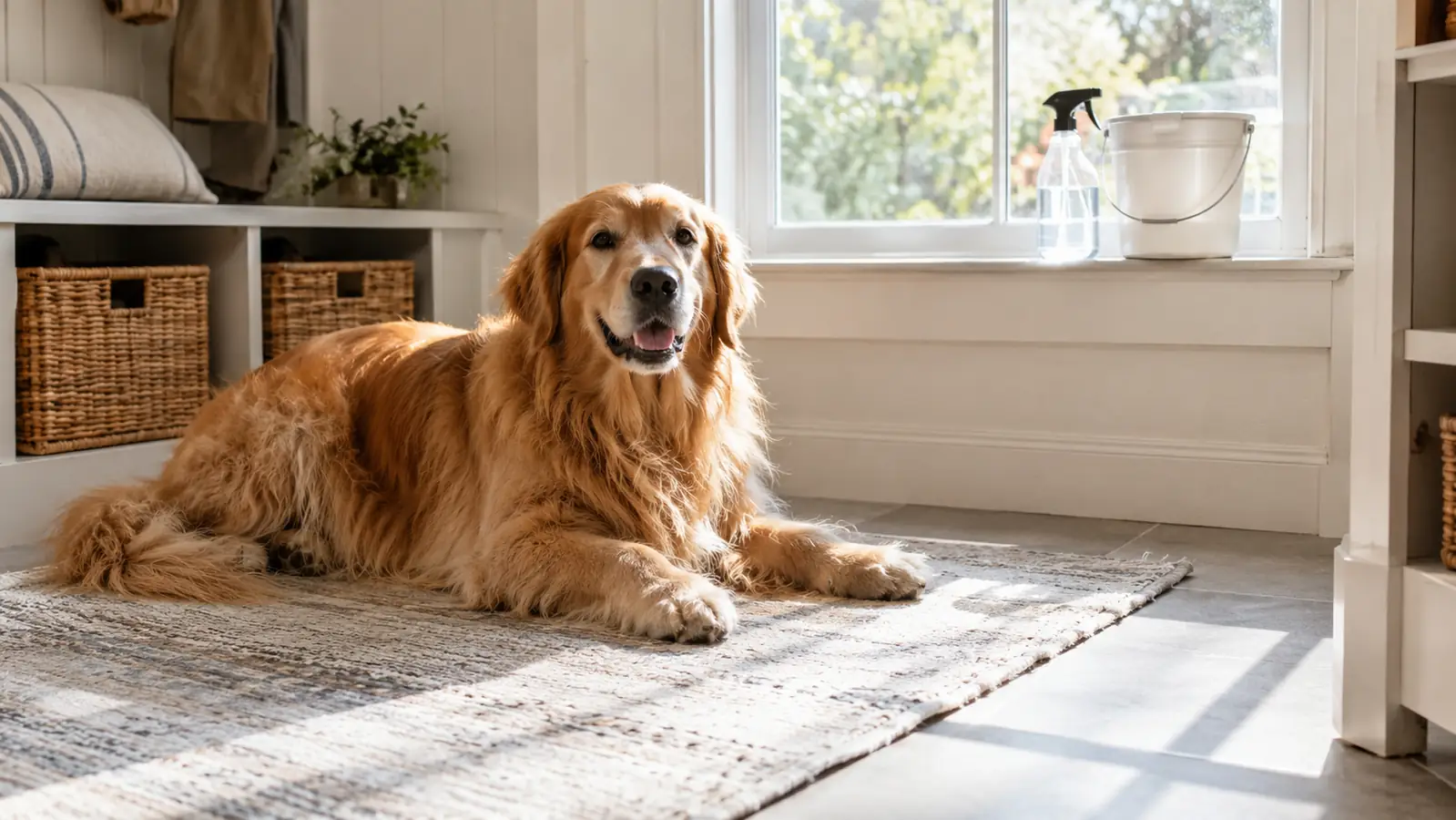
I ran a licensed in-home dog boarding business out of my ranch house outside Loveland, Colorado, for eleven years. At any given time I had four to six guest dogs staying with me, plus my own Australian Shepherd mix, Juniper. That is a lot of urine, and I am not being delicate about it. Puppies who have never been away from home, old dogs on new medications, nervous dogs who refuse to go out in a storm, all of them mark a house in ways you do not expect until you are living in it. I tried every cleaner the big box stores sold. The one I kept buying, gallon after gallon, was Rocco & Roxie Supply Co.'s Enzyme Stain & Odor Eliminator.
This is not a review of how it handled one accident. This is what eleven years of daily use taught me about what it does well, where it falls short, and who should spend money on it.
The Quick Verdict
The best all-around enzyme cleaner I used in eleven years of boarding dogs. It removes odors rather than covering them, works on the worst urine stains I ever dealt with, and one gallon lasts a small boarding operation a long time. It is not magic, you still have to scrub, but it is the closest thing to a set-and-forget cleaner I found.
Amazon Check Today's Price →The cleaner I kept refilling for eleven years
If you are cleaning up after your own dog or a houseful of guest dogs, this is the gallon jug I reached for every single time. Check today's price on Amazon and see if it beats what you are using now.
Amazon Check Today's Price on Amazon →How I've Used It
My boarding room was a converted mudroom off the back of the house, with linoleum floors, a washable rug, and a door straight out to the fenced side yard. That room saw everything. New puppies who had never slept away from their people, a nervous beagle we boarded one Christmas who cried all night, and a senior Lab whose medication meant he could not always hold it until the door opened.
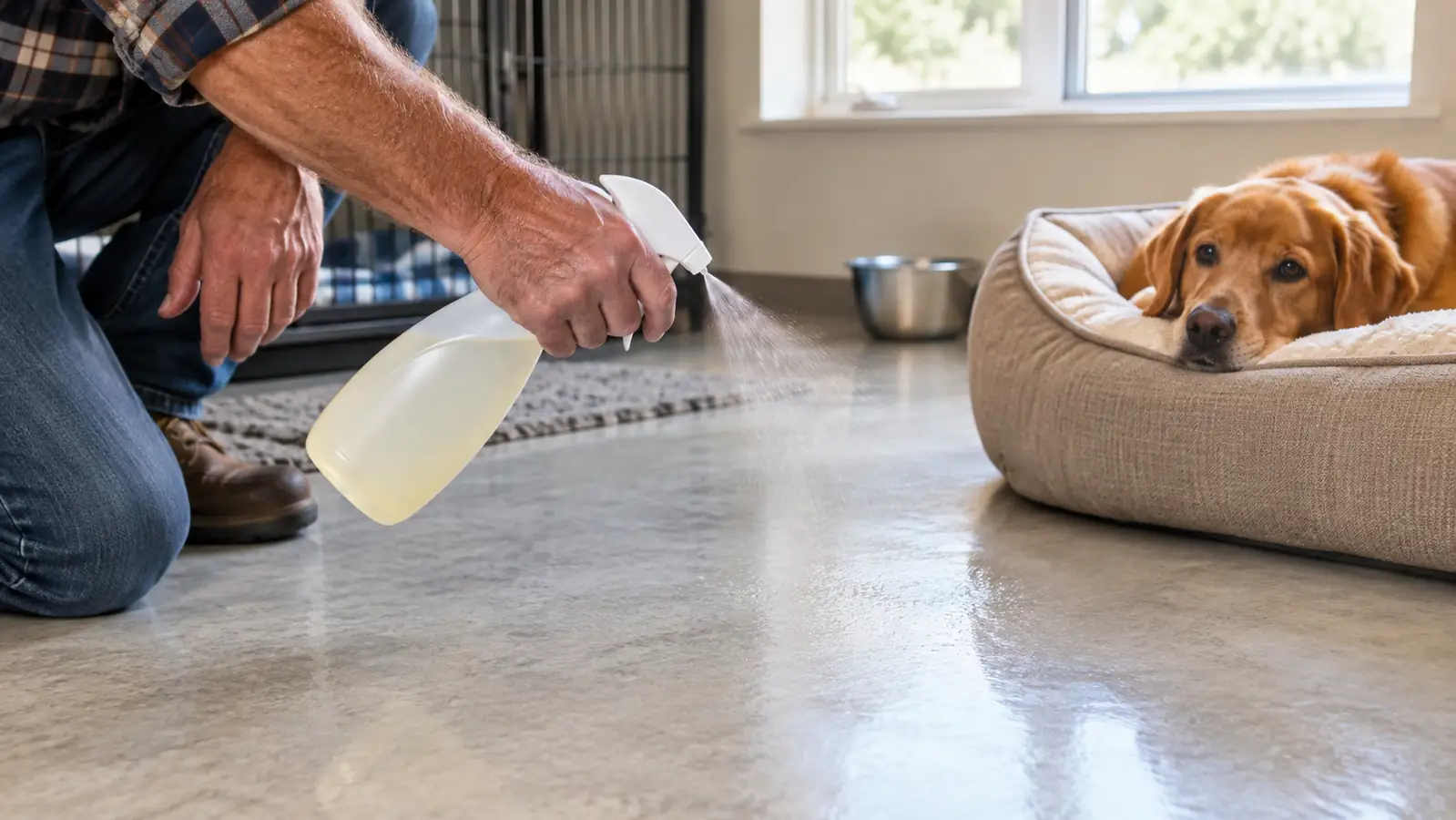
My routine was simple. I blotted up as much of the mess as I could with paper towels first, then sprayed the area until it was wet, let it sit for ten or fifteen minutes, and blotted again. For dried or set-in stains I sprayed, let it sit longer, sometimes overnight, and then scrubbed with a stiff brush before rinsing. I used it on linoleum, grout, a washable rug, a couch cushion, and a mattress once. I also kept a spray bottle mixed with water in the garage for the times Juniper got sick on the car seat cover in my old Subaru Outback.
One incident from January 2019 taught me the baseboard trick. A client dropped off a nine-month-old Bernese Mountain Dog mix the day before a snowstorm hit, and the pup had never been boarded before. She was so anxious she refused to go outside for the first twenty hours, and she had three accidents in the mudroom, all on the linoleum. The third one landed in the corner where the floor met the baseboard, and urine wicked up into the seam before I found it. I cleaned it the way I always did, paper towels first, a generous spray, ten minutes, blot. For two days that corner smelled no matter what I did. Finally I soaked a clean rag in the cleaner, pressed it flat against the seam, and taped it in place overnight. By morning the smell was gone. I used that rag trick on every wall-adjacent accident from then on, and it never failed.
I cannot tell you the exact number of gallons I went through. I can tell you I bought it by the case for the last several years of the business, and I never once felt the need to switch brands.
What Makes an Enzyme Cleaner Work
The reason enzyme cleaners work where bleach and vinegar fail is simple. Urine is not just liquid. It contains uric acid, which crystallizes and bonds to porous surfaces. A regular cleaner might remove the wet stain, but the uric acid stays behind, and the next time the area gets damp, the smell comes back. That is why a dog will keep returning to the same spot no matter how many times you scrub with soap.
An enzyme cleaner uses proteins that actually digest those organic compounds. The enzymes break down the uric acid into carbon dioxide and ammonia, which evaporate. When it works correctly, the odor is gone, not covered. That is the difference between a cleaner that solves the problem and one that just makes the room smell like lemon for an afternoon.
Rocco & Roxie Supply Co. uses a blend of enzymes and bacteria, and the label says it is safe to use around pets once dry. I am not a chemist, and I am not a vet. What I can tell you is that in eleven years of spraying this stuff on floors and rugs that dogs slept on, I never saw a single dog have a reaction to it. Juniper has a sensitive stomach and has never once shown interest in licking a treated spot, which tells me the residue does not smell like something a dog wants to eat.
Temperature and coverage turned out to matter more than the label suggests. Enzymes work best in a warm, damp environment, so I stopped rinsing with ice-cold water. In the winter my mudroom hovered around 58 degrees, and I noticed the cleaner took noticeably longer to work. I started turning the heat up a few degrees after an accident and letting the spray sit in a warm room. It cut my wait from about twenty minutes to ten. I also learned to use more than I thought I needed. A light mist is not enough. The surface has to be visibly wet, and for a dried stain I used enough that it pooled slightly. Out of curiosity I measured it once: a fresh accident on linoleum took about two ounces of cleaner to cover a spot the size of a dinner plate, and a dried stain took closer to four ounces plus the overnight soak.
What Held Up Over Years of Daily Use
The biggest surprise was how well it handled set-in stains. I bought the house with a previous owner's dog who had clearly used one corner of the mudroom as a bathroom for years. The grout in that corner was dark, and the smell hit you the second you walked in. I sprayed that corner every few days for about three weeks, let it soak overnight each time, and scrubbed with a nylon brush. By the end of the month, the smell was gone. The grout was never white again, but I stopped noticing the corner entirely, and so did the dogs. None of them ever marked there again.
It also held up on fabric. A guest dog once had an accident on my washable rug, and I sprayed it, let it sit, and ran it through the wash. The rug came out with no smell at all. Another time a very old, very sick dog had an accident on my couch cushion. I sprayed the cushion, let it sit overnight, and blotted it dry. The cushion was not ruined, and the room did not smell like urine. That is the outcome that made me a believer.
The scent is worth mentioning. It is not perfume. It has a mild, slightly citrusy smell that fades quickly, and it does not clash with the way a house is supposed to smell. Some enzyme cleaners leave a strong artificial fragrance that makes me wonder what they are hiding. This one does not.
The worst single accident I ever cleaned happened in April 2021. A thirteen-year-old Golden Retriever with kidney disease was staying with us, and her medication made her drink constantly. She had an accident on the washable rug in the middle of the night, and by the time I found it at six in the morning, urine had soaked through to the rubber backing and spread into a patch about two feet across. I blotted what I could, sprayed the whole area until it was soaked, and let it sit for four hours while the dogs were out in the yard. When I came back, I blotted again, sprayed a second time, and left it overnight. After the second treatment, the rug smelled clean and stayed clean for the rest of her stay. That was the moment I stopped doubting whether enzymes actually digest uric acid instead of just covering it.
Where It Falls Short
It is not magic. If you spray it on a dried, crusted stain and wipe it up immediately, you will be disappointed. The enzymes need time to work. I learned to let it sit, and the longer it sits, the better it works. For fresh accidents, ten minutes was usually enough. For old stains, I left it overnight.
It also will not fix a saturated carpet pad. If urine has soaked through to the padding beneath a carpet, no spray-on cleaner can reach it. I learned this the hard way with a rug that had a rubber backing. The surface smelled fine, but the padding underneath had absorbed the urine, and the smell came back every time the room got humid. The only real fix was replacing the pad. That is not a failure of the cleaner. It is a limitation of any spray product.
The spray nozzle on the gallon jug is serviceable but not great. It produces a decent stream, but it can clog if you leave it sitting for a long time. I kept a separate spray bottle filled from the gallon, which worked better and let me keep one in the garage and one in the mudroom.
I found the carpet pad limit the hard way in the summer of 2018. A guest dog with a urinary tract infection had an accident on a wool area rug in the living room, and I did not catch it for several hours. The surface cleaned up fine with the enzyme spray, but the pad underneath was saturated. Every time the humidity went up, the smell came back. I tried three treatments, each one an overnight soak with the rug lifted at the edges, and the surface stayed clean while the room still smelled. In the end I had to replace the pad. The cleaner did its job on everything it could reach, but it cannot travel through a rubber backing and a half-inch pad. If you have wall-to-wall carpet, I would buy a small carpet cleaner machine and use the enzyme product in the tank, because a spray alone will not save you.
What I Liked
- Removes odors at the source instead of covering them with fragrance
- Worked on the worst set-in urine stains I dealt with in eleven years
- Safe to use around pets once dry, in my experience
- One gallon lasts a long time, even with multiple dogs
- Mild scent that fades quickly
Where It Falls Short
- Needs time to work, you cannot spray and wipe and expect results
- Will not fix urine that has soaked into carpet padding
- The spray nozzle on the gallon jug can clog
- Not a substitute for actually cleaning the surface first
The corner that smelled like a previous owner's dog for years smelled like nothing after three weeks of overnight soaks. That is the result that made me a believer.
Who This Is For
This is for anyone who lives with a dog and has ever sniffed a room and wondered where the smell is coming from. It is for new puppy owners who are going to spend the next six months cleaning up accidents. It is for people who board dogs, foster dogs, or watch a friend's dog for a weekend. It is for anyone who has tried a regular cleaner and found that the dog keeps returning to the same spot. If you are cleaning up urine more than once a week, this is worth the shelf space.
Who Should Skip It
Skip it if you are looking for a quick spray-and-wipe product. If you are not willing to let it sit, you will not see the results that make people recommend it. Skip it if you need to fix a carpet that has been soaked through to the padding, because no spray will do that. And if you prefer a heavily fragranced cleaner, this is not that. It is a working product, not a perfume.
One more thing. If you are dealing with a dog who is suddenly having accidents in the house when they never did before, that is a conversation for your vet, not a cleaner. I saw it more than once with older dogs, and it was often a medical issue. Rocco & Roxie Supply Co. will clean up the mess, but it will not tell you why your dog is making it.
The gallon jug that survived a decade of boarding dogs
If you are tired of cleaning the same spot over and over, this is the enzyme cleaner I kept refilling for eleven years. Check today's price on Amazon and see why it earned a permanent spot in my mudroom.
Amazon Check Today's Price on Amazon →