
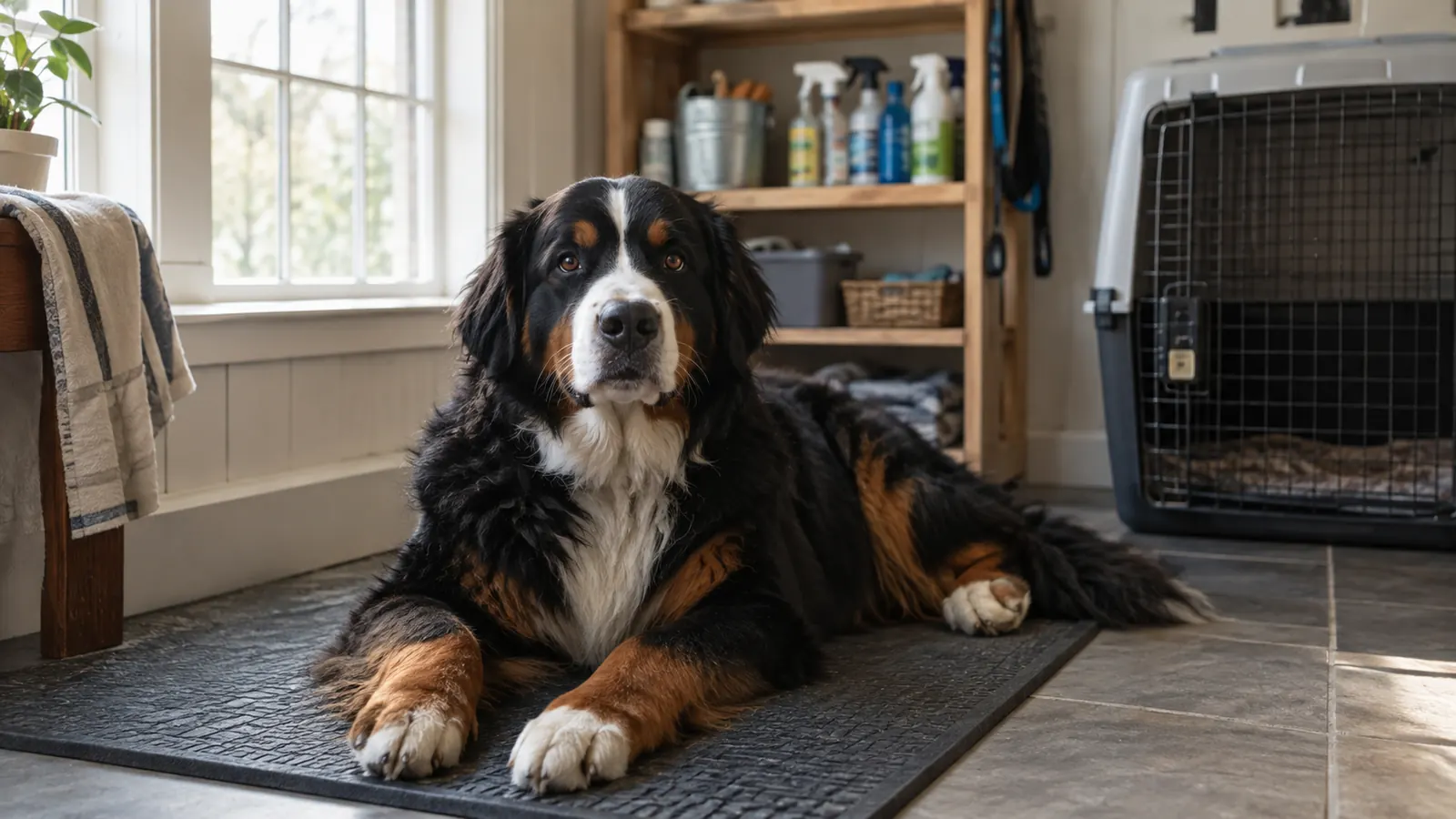
Eleven years of home dog boarding teaches you things no one puts on a website. It teaches you that a nervous dog will find the one rug you forgot to move. It teaches you that 'house trained' means different things to different owners. And it teaches you which cleaning products actually earn their shelf space. The Rocco & Roxie Supply Co. enzyme cleaner earned its spot in my mudroom within the first month, and it has stayed there ever since. But I want to be straight with you, the way I would be if we were standing in my kitchen: this stuff is good, and it is also not the effortless product the reviews make it sound like. It has a smell. It takes time. And it will not do the work for you.
I started boarding dogs in 2013, after I retired from the county clerk's office, and I kept at it until last spring. At my busiest I had four guest dogs in the converted mudroom plus Juniper, my Australian Shepherd mix, supervising from the hallway. That is a lot of paws on a lot of surfaces. I have cleaned up accidents from puppies, seniors, and one very stressed Great Dane who had never been inside a house. I have scrubbed kennel mats, crate trays, baseboards, and a section of drywall that one determined beagle worked on overnight. This cleaner was the one I trusted for all of it.
The Quick Verdict
A genuinely effective enzyme cleaner that removes odors instead of covering them, with two real drawbacks: the cleaner itself has a strong smell, and it needs time to work. For serious messes, it is hard to beat.
Amazon Check Today's Price →The gallon jug that survived eleven years of guest dogs
If you are dealing with pet stains and odors, this is the cleaner I kept in the mudroom for every boarding season. It removes the smell instead of hiding it, and a gallon goes a long way.
Amazon Check Today's Price on Amazon →How I've Used It
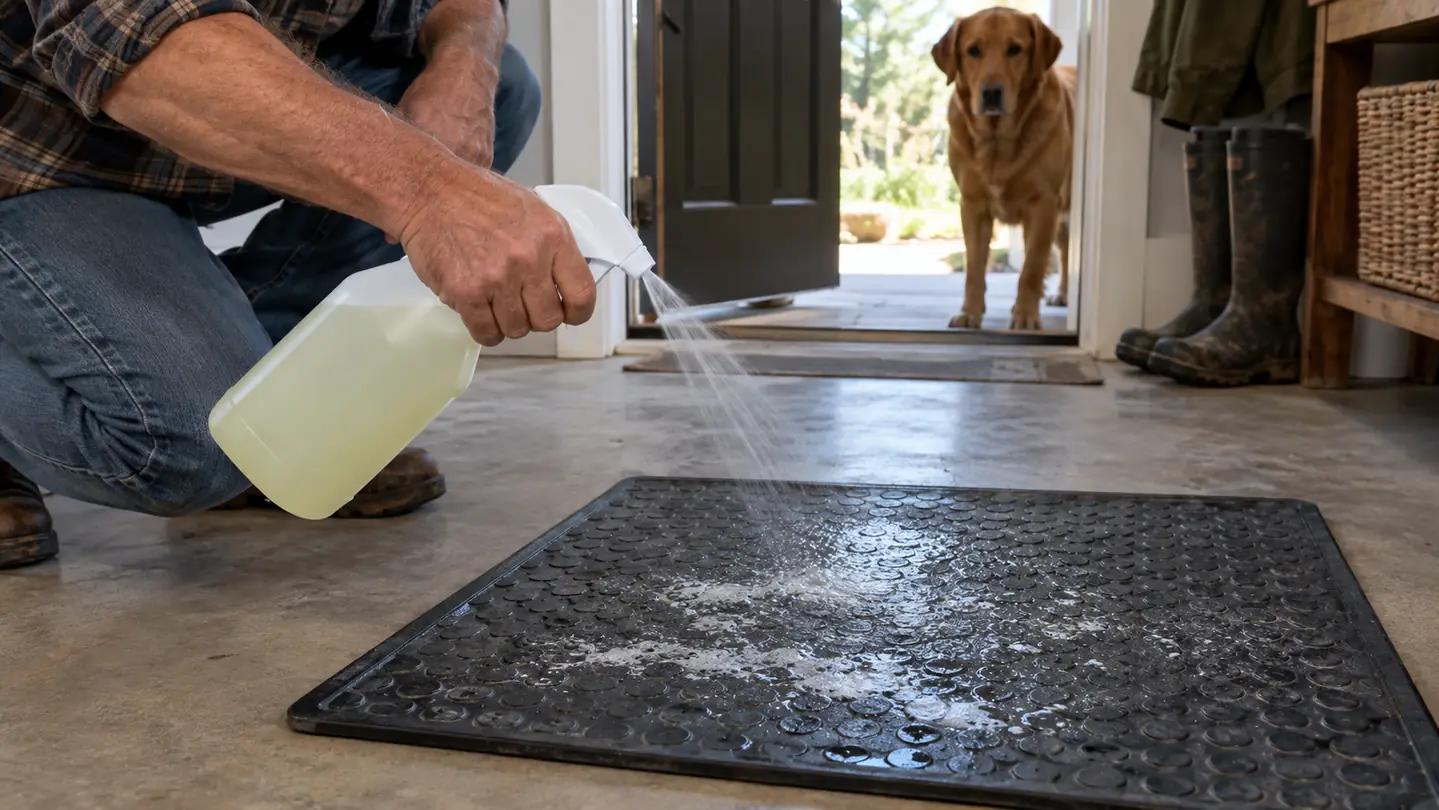
In my boarding room, the routine was always the same. The moment I noticed a mess, I blotted up what I could with paper towels, sprayed the area with the enzyme cleaner, and then did the hardest part: I walked away. Enzyme cleaners need time to work, and that goes against every instinct of someone who cleans for a living. I wanted to scrub. The product instructions say to let it soak, and they mean it. When I let it sit for ten or fifteen minutes, the results were consistently better than when I rushed.
I used it on the concrete floor of the mudroom, on the rubber kennel mats, on the plastic crate trays, and on the old carpet in the den that I should have replaced years ago. It also became my go-to for the fenced side yard, where guest dogs liked to mark the same patch of gravel. I would pour a little into a spray bottle, douse the spot, and let the enzymes do their thing. It did not matter whether the weather was warm or cold, though it worked faster in warm weather.
The gallon jug is plain and functional, which I appreciate. It is heavy when it is full, so I kept it on a low shelf in the mudroom rather than up high. The cap is simple and I never had it leak, which is more than I can say for some other cleaning products I have bought. The instructions on the label are clear: shake well, apply, let it soak. I also learned to wipe the rim of the bottle, because the liquid can dry into a crust that makes the cap hard to open. One thing I wish someone had told me: a little goes a long way. In the early years I would soak a spot until it was dripping, and I went through bottles faster than I needed to. Once I learned to use just enough to cover the area, a gallon lasted me through several months of regular boarding. That matters when you are buying for a household with multiple dogs. I also learned to shake the jug before each use, because the enzymes settle at the bottom over time.
What the Enzyme Cleaner Actually Does
Here is the part I had to learn the hard way. Ordinary cleaners lift dirt and kill some bacteria, but they do not break down the proteins in urine, vomit, and feces. Those proteins are what keep a spot smelling like a toilet to a dog's nose long after you cannot smell anything. An enzyme cleaner introduces living enzymes that eat those proteins. That is why the spot does not just smell clean. It stops inviting the dog back to the same place.
The Rocco & Roxie Supply Co. version is a blend of enzymes and bacteria, which sounds like science-class talk until you see it work on a stain that has been there for weeks. I had a spot in the den from a senior Lab who stayed with us one February. I had cleaned it twice with my regular floor cleaner and the smell kept coming back whenever the heat kicked on. One good soak with the enzyme cleaner, left to dry overnight, and the smell did not return. That is the difference between covering a smell and removing it.
I am not a veterinarian, and I am not going to pretend to be one. The label on the Rocco & Roxie Supply Co. bottle says the product is safe to use around pets when you follow the instructions, and in eleven years I never had a problem. But I also kept it on a high shelf, out of reach, and I never sprayed it directly at a dog's face or let a dog lick a wet spot. Common sense goes a long way. If you have a dog with a medical condition, or a dog who likes to eat things, ask your vet before you introduce any new cleaning product.
The other thing I learned is that enzyme cleaner is not a substitute for good hygiene. I still washed the kennel mats with hot water and soap on a regular schedule. The enzyme cleaner handled the spots and the smells, but it did not replace the weekly deep clean. Think of it as the specialist you call for the hard cases, not the whole maintenance crew.
I also learned to test it on a hidden corner first. Most of my floors and fabrics never had a problem, but a dark wool throw rug faded slightly where I soaked it, and I would rather you find that out on the underside of a rug than in the middle of your living room. Spot test, wait a day, then go ahead.
What Nobody Tells You About the Smell
Every review will tell you this cleaner removes odors. Very few will tell you that the cleaner itself has a strong smell while it is wet. It is not a bad smell, exactly, but it is noticeable. It reminds me of a mix of yeast and citrus, and if you use it in a closed room, you will know it. The first time I used it, I opened the mudroom window and turned on the little fan I keep out there. The smell faded as the surface dried, and once it was dry, I could not smell the cleaner at all. But the wet phase is real.
This matters if you are cleaning a room right before guests arrive or if you have a dog who is sensitive to strong scents. I never had a dog react badly to it, but I also made a point of letting the room air out before any dog went back in. If you are the kind of person who wants a cleaner that smells like a meadow, this is not that. It smells like a product that is working.
How It Holds Up on Different Messes
Over eleven years, I tested this cleaner on just about everything a dog can produce. Fresh urine on concrete: excellent, one spray and a soak and the smell was gone. Old urine on carpet: good, but it took two or three applications and a lot of patience. Vomit on a rubber mat: very good, especially if I got to it before it dried. Diarrhea in a crate tray: the tray had to be emptied and rinsed first, and then the cleaner did its job. Feces on drywall, from the beagle I mentioned: the drywall had to be patched, but the cleaner kept the smell from soaking into the studs.
The one thing it did not do well was dissolve a mess that had already dried and crusted. You have to remove the solid material first. Enzyme cleaner is not a liquid that makes a dried mess disappear. It breaks down what is left after you have done the gross part. That is the honest version, and it is the reason I always kept a roll of paper towels and a plastic scraper next to the bottle.
For an old stain, what worked was scraping off anything solid, rinsing the spot with plain warm water, blotting it nearly dry, and then saturating it with the enzyme cleaner. I mean saturating: enough to reach the pad under a rug, not a light mist on top. Then I covered it with a damp towel so it would not dry out too fast. It usually took two rounds over two days, but it got there.

Where It Falls Short
The biggest drawback is time. This is not a spray-and-walk-away product, even though the label makes it look easy. You need to let it soak, and for older stains you need to repeat the process. If you are cleaning a kennel between guests and you have fifteen minutes before the next dog arrives, you will be tempted to skip the soak. I did, and the smells came back.
The second drawback is the smell of the product itself, which I already mentioned. The third is that it is not the cheapest option on the shelf, and for someone with a single dog who rarely has accidents, a basic cleaner might be enough. I would not tell a friend with one well-trained adult dog to buy a gallon of this. I would tell them to buy a smaller bottle for the occasional emergency.
I tried plenty of cheaper enzyme cleaners during my boarding years, the kind you find at the big-box pet store for a bit less. Some of them worked okay on fresh urine. None of them worked as well on the old, set-in stains that the Rocco & Roxie Supply Co. version handled. The difference was not dramatic on easy messes. It was dramatic on the hard ones, the spots that had been there for weeks and the smells that seemed to live in the baseboards. When I needed something to work the first time, I reached for the gallon jug.
That is not to say the expensive one is always better. I have bought plenty of expensive products that disappointed me. But in this case, the extra cost bought real performance. I would rather buy one gallon of something that works than three bottles of something that only sort of works.
Here is how I finally settled the question for myself. One spring I split a single stained runner down the middle with painter's tape. The left half got a cheaper store brand, the right half got the Rocco & Roxie cleaner, both soaked the same way and covered with a towel overnight. Two days later, Juniper walked straight past the right half and stopped to sniff the left half for a long minute. That told me more than any label did.
What I Liked
- Removes odors at the source instead of covering them
- Works on old stains when you give it time
- Safe to use around pets when you follow the instructions
- A gallon jug lasts a long time
- Does not attract dogs back to the same spot
- Holds up on concrete, rubber, plastic, and carpet
Where It Falls Short
- The cleaner has a strong smell while it is wet
- Needs soak time, sometimes multiple applications
- Does not dissolve dried messes on its own
- More product than a single-dog household needs
The difference between a cleaner and an enzyme cleaner shows up on day two, when the spot stays dry instead of drawing the dog back.
Who This Is For
This is for people who live with more than one dog, for puppy owners who are in the middle of house training, for people caring for a senior dog who has started having accidents, and for anyone who boards dogs or runs a small kennel. It is also for anyone who has a spot in the house that smells like dog no matter how many times you wipe it. If you have ever sniffed a carpet and wondered where the smell is coming from, this is the product for you.
Who Should Skip It
Skip it if you have one adult dog who is reliably house trained and you only need a surface cleaner for the occasional muddy paw. Skip it if you are sensitive to strong-smelling cleaning products, because the wet stage is noticeable. And skip it if you are looking for a one-step product that will dissolve dried messes without any scrubbing or preparation. This cleaner is a tool, not a replacement for the work of cleaning.
One more group I would steer away from it: anyone hoping to clean a mess in thirty seconds before company walks in. If your routine is wipe, spray, and move on, you will be disappointed, and you will probably blame the bottle when the real problem is that you never gave the enzymes time to work. Set a kitchen timer if you have to. I kept one on the mudroom windowsill for exactly that reason.
Final Thoughts
I do not love every product I used during my boarding years. I have thrown away plenty of things that did not work. The Rocco & Roxie Supply Co. enzyme cleaner is not one of them. It earned its place, and I still keep a bottle in the mudroom even though I am not boarding anymore. Juniper is seven now and she has not had an accident in years, but the bottle stays. Some tools are worth keeping around, just in case.
If you are on the fence, buy the smaller size first and try it on the worst spot in your house. That is what I tell everyone who asks. You will know within a week whether it works for you.
The bottle I still keep in the mudroom
After eleven years of boarding dogs, this is the enzyme cleaner I trusted with every kind of mess. If you have a stain or smell that keeps coming back, it is worth trying.
Amazon Check Today's Price on Amazon →